
A faint echo in our growing (news) desert
The rapid disappearance of local newspapers spells trouble for many small communities across the country. The Alice-Echo News Journal in Alice, Tx is Jim Wells County’s only remaining paper. Jim Wells is one of over 1,700 counties with only one or zero newspapers remaining.
By: Frankie Leal
Jim Wells County in South Texas consists of only three towns with a population of at least 1,000: Alice, Orange Grove, and Premont. Alice is the largest of the three and is home to the county’s last remaining newspaper, The Alice-Echo News Journal.
Others nearby like The Orange Grove Observer or the Robstown Record covered the area too. However, it’s been decades since they folded.
Although technically in neighboring Duval County, the town of San Diego sits only 8 miles to the west of Alice. The Duval County Picture, another local newspaper, served the community of San Diego for many years, but they closed their doors in the early 2000’s, leaving the Echo and The Premont Journal as the last remaining newspapers for Jim Wells County. The Premont Journal then ceased production in 2010, so the Echo has been the lone newspaper across Jim Wells County and Duval County for 12 years.
Local newspapers across the country, some of which have been around for over a century, have been closing their doors at an alarming rate, creating more and more news communities that lack local news sources. Jim Wells County is just a drop in the bucket, one of 1,740 counties across the United States with one or zero remaining newspapers.
In 2018, The Siftings Herald in Arkadelphia, Arkansas closed after 127 years. Their editor at the time, Rex Nelson, found the loss of his local newspaper and other local newspapers concerning and wrote in an editorial:
“The watchdogs of school boards, city councils and quorum courts are gone. The chroniclers of high school sports teams are missing. To say that this is a sad thing for these counties is to understate the case,” said Nelson at the time.
What are News Deserts?
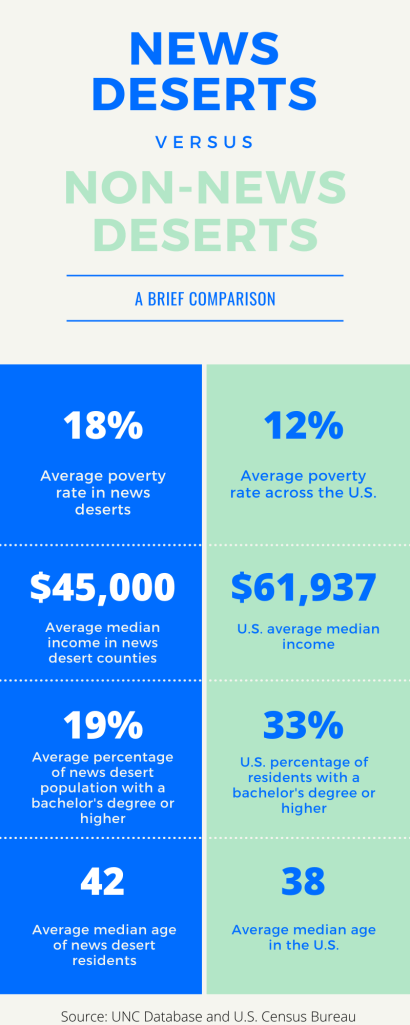
While there’s no concrete definition, news deserts are counties that lack consistent and reliable access to news, and those counties are generally those with one or zero sources of local newspapers.
According to Penelope Muse Abernathy’s study titled “The Expanding News Desert,” a news desert is a community, either rural or urban, with limited access to the sort of credible and comprehensive news and information that feeds democracy at the grassroots level.
In the United States, there are now over 1,500 counties with only one local newspaper, and more than 200 counties have no local newspapers at all.
America’s news desert continues to expand every year, getting larger every time a local newspaper is forced to raise the white flag and shut their doors. Across the United States, over 2,100 newspapers closed between 2004 and 2020, the majority of which were smaller, weekly publications. In Texas alone, the total number of weekly newspapers declined from 548 to 368 between 2004 and 2018 (see here).
Many communities are losing news coverage on elementary school science fairs, high school sports, city government policies, and much more. A recent study by Duke University of 100 mid-sized communities found “local newspapers significantly outperformed local TV, radio, and online-only outlets in news production, both in overall story output and in terms of stories that are original, local, or address a critical information need.”
This means that for many communities, the local newspaper remains the best source to get news and information about topics such as local education, government, and other localized issues.
The loss of local newspapers can have several negative impacts on the communities they serve. According to Abernathy’s Expanding News Desert, counties without a local news presence see things like:
- Lower voter turnout
- Lower rate of community participation
- Higher toxic emissions from chemical plants
- Less parity in local elections
- Higher rate of financial corruption from local government
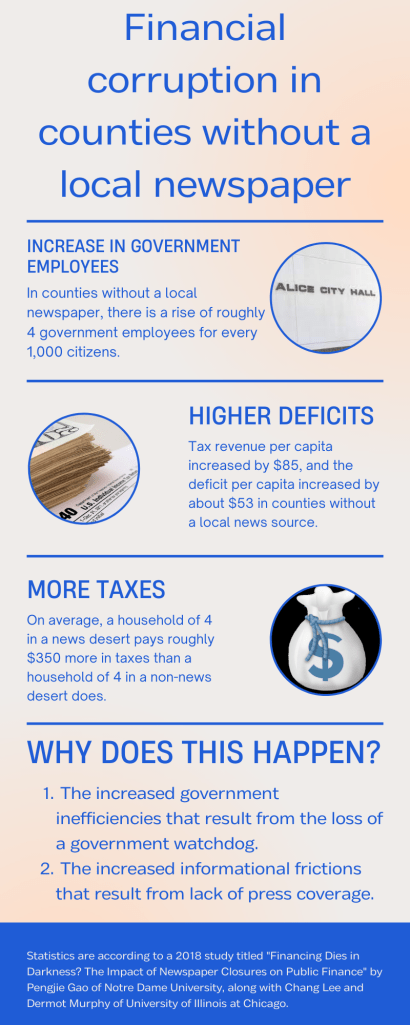
In 2022, the local newspapers that still exist have had to make enormous sacrifices to keep their heads above water. Between 2008 and 2018, the newspaper industry saw a 47% drop in employment, leaving the surviving newspapers with scant resources.
The Echo is one of those newspapers. As the lone newspaper in Jim Wells County, the Echo still consistently reports on local events for the community of Alice and its surrounding towns like San Diego, Orange Grove and Premont.
However, they’ve recently had to switch to printing only twice a week instead of three to save money, and their staff is now made up of only two full time employees. It’s clear they’re feeling the effects of a changing world that is rapidly pushing local newspapers out of existence.
Despite this, Echo editor Melissa Trevino remains optimistic.
“I see us being here for a long, long time,” said Trevino. “I don’t think we’re going anywhere.
Meet Melissa Trevino, editor of the Alice-Echo News Journal
Melissa Trevino, managing editor of the Echo, discusses the role the Echo plays in the community of Alice and Jim Wells County.
“When the community trusts you, they’re going to help you.”
– Melissa Trevino
Weekly newspapers in trouble
Out of the 6,730 surviving newspapers in the United States, over 5,400 of them are non-dailies or weeklies. Three-fourths of newspapers in this country have circulations under 15,000, meaning they serve smaller communities.
Meet some of the residents of Jim Wells County
Varying perceptions of the Alice Echo

Dr. Suraj Govind Kamat (Cardiologist)
Dr. Kamat has been Jim Wells County’s lone cardiologist since he moved to Alice in the late 1990’s. Dr. Kamat harbors a casual indifference towards the Echo.

Cynthia Carrasco (Mayor)
Carrasco was elected to her first term as Mayor of Alice in May 2021. A resident of Jim Wells County for nearly three decades, Carrasco believes the Echo still provides value to the people in the community.

Richie Hinojosa (Detective) & Allyson Kohler (Student)
Hinojosa and Kohler both believe the community would be able to survive fine without the Echo, due to the presence of Facebook and other social media.
Stripped but still standing
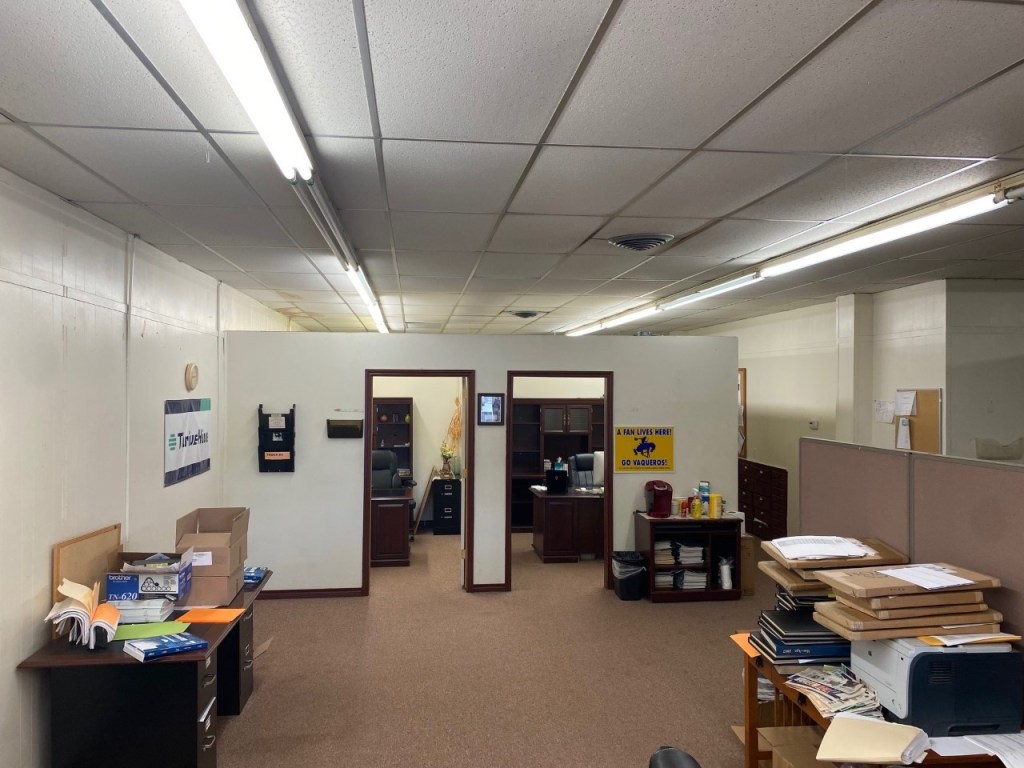
When Melissa Trevino began as a reporter at the Alice-Echo in 2013, the staff totaled roughly a dozen people. Today, the newsroom sits nearly vacant, as there are only two full time employees. Across the United States, the number of employed newspaper journalists dropped from over 71,000 to 30,000 between 2004 and 2020.
 save-local-news.com